Jumat, 27 Juli 2012

Many people are interested in having a saltwater aquarium in their homes. Here are a few things we'd like to suggest when you consider setting up a tropical saltwater aquarium.
Obtain a copy of a good reference book on setting up an aquarium. This will help you avoid frustration as you pursue your hobby. Most pet stores and libraries have good reference materials.
Learn about the animals you wish to have. Carefully consider the largest size an animal will grow before you purchase it for your home aquarium. While Sea World is capable of taking care of large fish such as nurse sharks, they probably should not be purchased for most home aquariums.
Make sure that food for the species you wish to have is consistently available. Some fish feed only on corals. These fish are difficult to keep in home aquariums because there is no commercial food supply available for them.
Be careful to purchase animals that are compatible and that will be able to live together in the size aquarium you have.
Ask your supplier to check water from your aquarium before you purchase animals. If your supplier is unable to test the water for you ask him for advice on the correct parameters of pH, ammonia, nitrates, etc.
Regularly test your aquarium water. You can use test kits that are available at your local pet store. The quality of the water in your aquarium is critical to the health to the animals.
Ask your local fish supplier how specimens have been collected. We encourage you to avoid any specimen that has been collected with the use of chemicals. Two of the common chemicals used are cyanide and chlorine bleach. These chemicals kill a large percentage of fish exposed to them. They also destroy other life on the reef, including corals.
Ask your supplier if the fish he carries are "hand caught."
Home Aquariums
Home aquariums provide many hours of enjoyment for the entire family. It is vital that the animals you have in your aquarium are given the care they need. The more you know about the animals, how they were collected, and how to provide them the best home, the more you will enjoy them.fish picture
Maintenance Tips:
1. Don't overfeed the animals.
2. Change 25% to 50% of the water at least once a month.
3. Develop a quarantine aquarium for new or sick animals.
4. When the water evaporates, refill with fresh, nonchlorinated water.
5. Any change in the salinity or temperature should be made slowly. (Changing salinity as a treatment to remove certain parasites (is an exception to this rule.)
6. Test pH and ammonia daily. Nitrates should be monitored at least once a week.

Don't hesitate to ask your local fish supplier or a local aquarium hobbyist group any questions you may have about your aquarium or the animals in it.


Antoinette gained her life experience when she completed 4 years in “Food and Clothing” at the Vaal Triangle Technicon (Vaal University of Technology).


After that she joined Finesse Magazine's department of Fashion and Design, but her dream and passion was to have her own business. That led to a BRAND being established. Though it is still a young business, it is bursting at the seams with all the incoming orders.

One day…

About a year ago, Antoinette with her special brand of creativity, designed and hand-made a hobby horse for a birthday present. Everyone that laid eyes on this horse also wanted to have one. Antoinette then got so busy making children's toys, which was absolutely "one of a kind" and thus Hobby Animals was born.

Each animal is carefully crafted by hand, and you can see her passion and love in each one of them. Antoinette says, for her it is no work making them, but more like playing, and that it is the most enjoyable occupation under the sun.

If you would ask me personally what the future holds for Hobby Animals - I would definitely say that it is a must for every household.

Kamis, 26 April 2012

Locked On: Hobby catching mayfly mid-flight

This is the split second before a Hobby plucks a mayfly from the air. A moment that is over so quickly you can barely register it’s happened when watching these lightening fast birds dart about the sky with the agility to match their impressive speed. Personally, I very rarely see Hobbies. I could count on one hand (almost one finger) how many times I’ve seen this bird of prey before, let alone 12 together! So when I recently had the pleasure of sitting in a field for several hours watching so many hunting mayflies mid-air, I was delighted to capture an image that shows just that split second before it’s all over for the mayfly.
A Hobby locks on to it's prey, a mayfly, mid-flight just moments before plucking it from the air.
The Hobby, about to pluck a mayfly from the air
Camera: Nikon D3s
Lens: 600 VR + 1.4x TC
Exif: 1/1600, f8, ISO 1100
Support: Gitzo GT 5541 LS, Wimberley MKII
If you’ve seen these birds hunt you will know just how amazingly fast they are, and keeping them in the viewfinder is hard enough, let alone getting images of them! Against a plain blue sky it’s fine but as soon as you have a backdrop with contrast and detail, it’s all the camera see’s. Another problem was they would fly in to the wind, which would slow them down slightly, but then they’d suddenly turn in to it and be gone like a shot. As a result I found myself having to manual focus as I tracked them through the lens, once I managed to find them of course, as the field of view at 850mm isn’t very big. I have to admit there is no more frustrating a feeling than having a species you don’t see very often, in so many numbers, right in front of you but there be such difficulty in getting an image. It’s part and parcel of wildlife photography though (and if I’m honest, part of what makes it so much fun!) and I’m glad we persisted as although this image is quite heavily cropped, if nothing else it serves to illustrate the frantic feeding action we witnessed whilst we were there – oh, and show that my manual focus hit rate for fast small moving birds is pretty low…lol
I’m not sure how well it comes across, but below is also a short video I filmed on my iPhone to show the Hobbies as they flew about the sky – of course, with a wide angle it probably looks like they were not moving that fast, but train a telephoto on them and they are like little rockets! lol

Bird Feeding – A Cheap And Enjoyable Hobby

By Ken Lawless  
As the economy continues to deteriorate, families find themselves having to  find entertainment and hobbies that they can afford and yet, still enjoy. As a  result, more and more families are rediscovery birding or feeding birds as a fun  inexpensive hobby.


Bird watching or birding, which is already one of the more popular past times  in the country, is destined to become even more popular. Feeding birds has  always been a hobby that many people without a lot of money enjoyed. Walk to any  city park on a nice day and you may see city residents sitting on the park  benches and dropping bread crumbs for the visiting birds. If you own a home, you  can do the same thing in your back yard.
Feeding birds is a fun activity that the entire family can enjoy together -  the adults as well as the children. You don’t need to buy special expensive  equipment, you don’t have to spend a lot of money traveling to far away places,  and you don’t have to build your schedule around the timing of specific events.  Birds are pretty much active at some sort of activity practically all times of  the day giving you plenty of time to enjoy your past time.
The key to attracting birds to your yard is providing them with food. You can  even aim towards attracting specific species of birds by placing their food  favorites it your back yard feeders. When birds discover that your yard has  food, which they eventually will, you may find your yard turning into a virtual  aviary.
And, if you have trees or suitable nesting places nearby, you may even find  some taking up residence in your back yard to be near the new source of food  that they have discovered. You may find that watching some of these bird  families are as much enjoyable a attending the latest romantic or action film in  the movies.
Finding nourishment to give to the birds is not expensive at all. In fact,  you can make quite a few of the recipes yourself. And, you don’t have to provide  all of the food that the birds eat, you are only supplementing it. It only takes  a little food to attract them to your garden or yard.
Introducing your kids to feeding birds teaches them how connected we all are  to nature and teaches them to respect it. Feeding birds is also an activity that  brings the family closer together. If history is a guide, your kids will look  back on this time you spent with them as some of the best times of their  lives.
You can find additional information on birds such as solar bird bath and bird houses at our website.

Hobby

Apart from stragglers, all our local swifts departed well in advance of mid-August. Their stay here is so short; in fact, I did not record them this spring until May 11. The skies are again silent and their shrill screaming greatly missed.
Shortly before the main swift departure my elder son became aware of high-pitched distress calls in his Thorpe garden. It was almost dusk, but within a short distance of his windows was a hobby pinning an unfortunate swift to the ground.
The hobby is one of the very few birds of prey capable of outflying swifts; perhaps at a speed approaching 100mph. The literature presents a full catalogue of victims, extending to escaped budgerigars which are taken regularly.
Hobbies provide impressive aerobatic displays spending much of their time in high soaring flight almost out of sight before plummeting earthward with closed wings at a great speed. Wings are spread only when the birds are within a few feet of the ground.
Fortunate observers have described exceptionally fast pursuit flights. These involve dashing over treetops, diving earthward together, sailing skyward to hang in the wind and then careering high in the heavens with the male even looping the loop as his partner twists and flies on her back to the accompaniment of shrill calls.
After the young hobbies leave the nest, their parents continue feeding them but within a few days they will hunt slow-flying beetles before turning their attention to such rapidly moving grey as dragonflies. Only much later, following prolonged aerial games, do they try hunting birds or bats.
Hobby in flightHobbies regularly hunt late in the evening seeking insects which appear at dusk, as well as on flocks of swallows about to enter reedbed roosts. A migrant hobby will sometimes linger for days at Hickling, Strumpshaw or Titchwell Reserves, each of which attracts swarms of roosting swallows during early autumn. Perhaps hobbies follow prey south to tropical Africa in the same manner that skuas follow terns.
A hobby in high aerobatic pursuit of flying prey demonstrates a wonderful mastery of the air. Victims are almost invariably taken on the wing, often consisting of birds which are themselves swift fliers.

Jumat, 20 April 2012


Hamster Ball

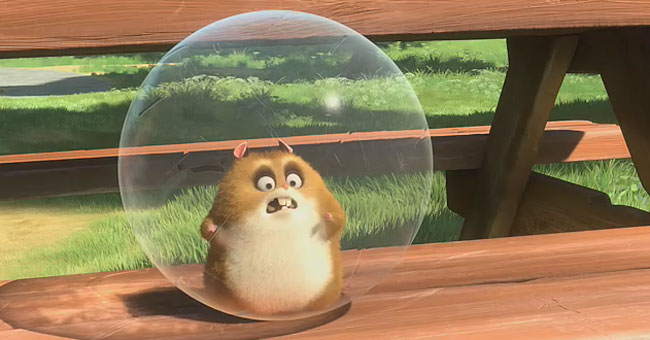
I ran into a rather unexpected bit of culture shock this weekend while watching TV with Mutsumi. Disney’s latest 3D animal flick “Bolt” has hit Tokyo and primetime television is loaded with commercials for the new movie. The lead cast of the film is made up of TV superstar dog Bolt, cat Mittens, and sidekick hamster Rhino, pictured below:
Rhino from Bolt
Perpetually cheerful hamster seemingly unfazed by his being trapped in a hamster ball. Not a bad setup for a comedic foil. Or so I thought until Mutsumi asked: “I wonder why he’s in that ball?” It hadn’t even occurred to me that Mutsumi had no idea what a hamster ball was. A quick survey among our Japanese friends came up with a variety of answers as to what they thought the mystery ball was: from a balloon to some sort of energy barrier to a medical bubble like the one used by that kid in Seinfeld. No one we asked thought that this was the sort of thing that someone would, or even should, willfully insert a living hamster.

It was time for a quick bit of internet education. A brief search on Google turned up several images like the one below (along with more than a few mentions of animal cruelty):
Hamster in a Ball
So, there it was. The hamster ball as a plastic toy into which hamster owners place their pets so they can run around the living room, but not get lost under the couch.
Mutsumi’s first reaction: “Oh, that’s awful!”
Mutsumi’s second reaction: “Can you play soccer with it?”
I also had to assure her that no sane person keeps their hamster in a ball all the time.
With the perpetual nature of Hollywood’s big releases, it’s funny the things you take for granted as common cultural knowledge. I wonder what Disney’s Japanese PR offices thought of Rhino’s hamster ball. Did they decide it was too hard to explain or did they just take it in stride? Who knows, maybe it’s all part of a larger marketing plan and I’m going to start seeing rodents running around in Bolt-branded hamster balls all over Tokyo.